Momentum Trading Strategies: Entry Setups and Real Trade Examples (2026)
Momentum trading is a strategy that capitalizes on the continuation of existing trends. The core principle is simple: assets that have been rising tend to keep rising, and assets that have been falling tend to keep falling. This guide covers momentum concepts, indicators, and real-world trade setups you can apply immediately.
What is Momentum Trading?
Momentum measures the rate of change in price. Unlike mean reversion strategies that bet on prices returning to average, momentum strategies bet on trend continuation.
Key principles:
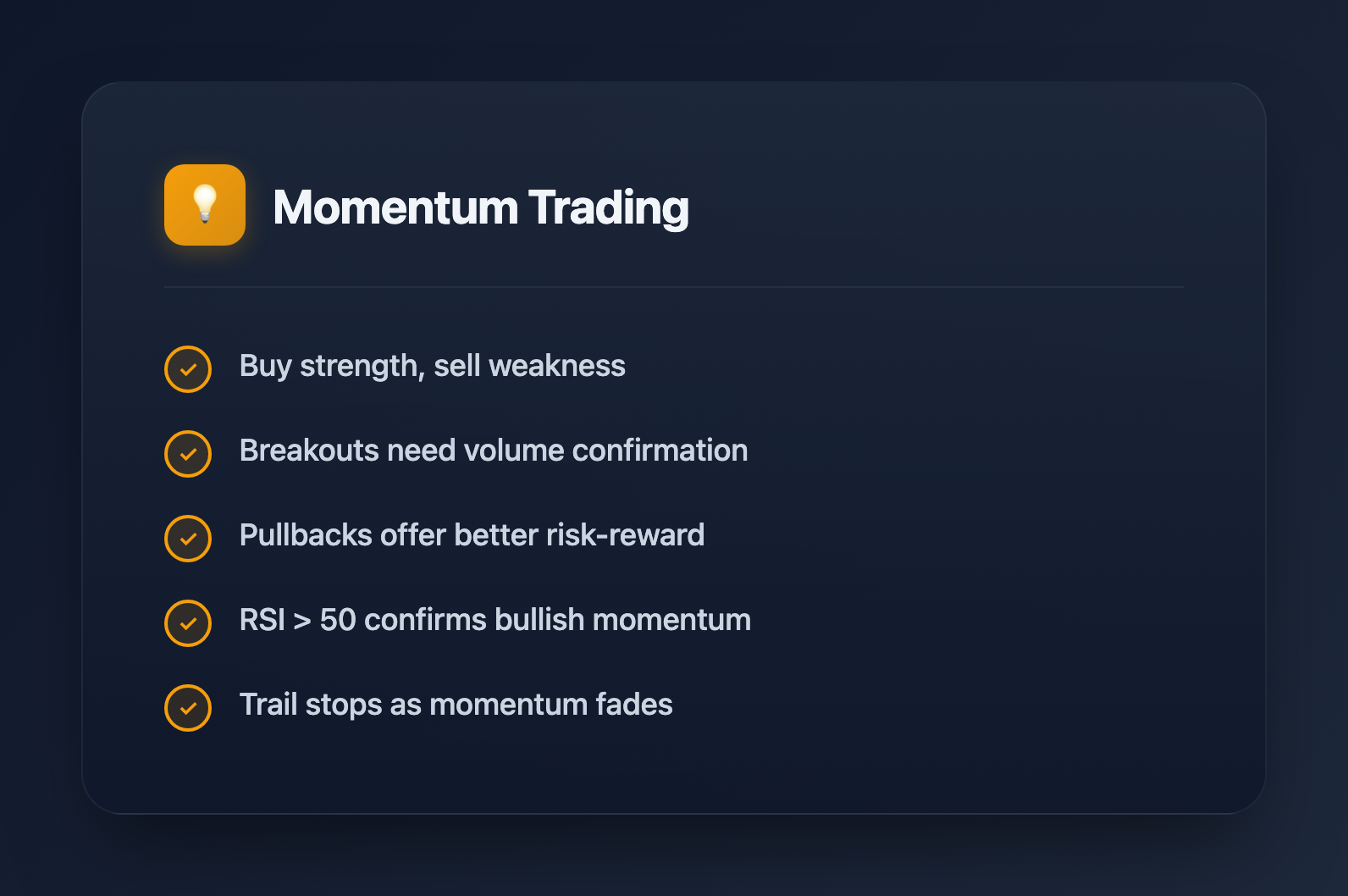
- Trend following: Buy strength, sell weakness
- Relative strength: Focus on outperformers vs. the market
- Time-based exits: Momentum fades—don't overstay
- Cut losers fast: When momentum reverses, exit quickly
Core Momentum Indicators
Rate of Change (ROC)
ROC = ((Current Price - Price n periods ago) / Price n periods ago) × 100

Example (10-day ROC):
Current price: $105
Price 10 days ago: $100
ROC = ((105 - 100) / 100) × 100 = 5%

Interpretation:
- Positive ROC = upward momentum
- Negative ROC = downward momentum
- Rising ROC = accelerating momentum
- Falling ROC = decelerating momentum
Relative Strength Index (RSI)
RSI = 100 - (100 / (1 + RS))
RS = Average Gain / Average Loss (over n periods, typically 14)

Interpretation:
- RSI > 70: Overbought (but can stay overbought in strong trends)
- RSI < 30: Oversold (but can stay oversold in strong downtrends)
- RSI 50 cross: Momentum shift signal

Momentum use: RSI > 50 confirms bullish momentum
              RSI < 50 confirms bearish momentum
MACD (Moving Average Convergence Divergence)
MACD Line = 12-period EMA - 26-period EMA
Signal Line = 9-period EMA of MACD Line
Histogram = MACD Line - Signal Line

Momentum signals:
- MACD above signal line: Bullish momentum
- MACD below signal line: Bearish momentum
- Histogram expanding: Momentum accelerating
- Histogram contracting: Momentum weakening
ADX (Average Directional Index)
ADX measures trend strength (not direction):

- ADX < 20: Weak trend or ranging
- ADX 20-40: Developing trend
- ADX > 40: Strong trend
- ADX > 60: Extremely strong trend

Use with +DI/-DI for direction:
- +DI > -DI: Bullish
- -DI > +DI: Bearish
Momentum Trade Setups
Setup 1: Breakout Momentum
Scenario: Bitcoin has been consolidating between $40,000-$42,000 for two weeks. Volume has been declining during consolidation.
Setup conditions:
- Price breaks above $42,000 resistance
- Volume spikes 2x+ average on breakout
- RSI crosses above 60
- MACD histogram turns positive
Trade plan:
Entry: $42,200 (confirmation above resistance)
Stop loss: $41,400 (below breakout level)
Target 1: $44,000 (1:2 risk-reward)
Target 2: $46,000 (measured move = range width added to breakout)

Position sizing (2% account risk):
Account: $50,000
Risk per trade: $1,000
Stop distance: $800
Position size: $1,000 / $800 = 1.25 BTC
Why this works: Consolidation represents accumulation. The breakout with volume confirms buyers are committed. Momentum indicators confirming the move reduces false breakout risk.
Setup 2: Pullback in Uptrend
Scenario: ETH has rallied from $2,000 to $2,800 over 3 weeks. It pulls back to $2,500 on lower volume.
Setup conditions:
- Price in established uptrend (higher highs, higher lows)
- Pullback to 20-day EMA or prior resistance (now support)
- RSI pulls back to 40-50 (not oversold)
- Volume decreases during pullback
- Bullish candlestick pattern at support (hammer, engulfing)
Trade plan:
Entry: $2,520 (after bullish candle closes)
Stop loss: $2,380 (below the low of pullback)
Target 1: $2,800 (prior high)
Target 2: $3,000 (extension)

Risk-reward: $140 risk for $280-$480 potential (2:1 to 3.4:1)
Why this works: Trends persist. Pullbacks offer better risk-reward entries than chasing breakouts. The decreasing volume on pullback shows selling pressure is weak.
Setup 3: Relative Strength Rotation
Scenario: You're scanning the market and notice SOL has gained 15% this week while BTC is flat and ETH is up only 3%.
Setup conditions:
- Asset outperforming its sector/market significantly
- RS line (asset/benchmark ratio) making new highs
- ADX > 25 showing trend strength
- Ideally pulling back after initial surge
Trade plan:
SOL/USDT setup:
Current price: $45 (after pullback from $48)
Entry: $45.50 (on bounce from 10 EMA)
Stop loss: $42.00 (below swing low)
Target: $54.00 (relative strength continues)

Risk: $3.50 (7.7%)
Reward: $8.50 (18.7%)
R:R = 2.4:1
Why this works: Relative strength indicates capital flowing into that asset specifically. Money follows performance—institutional buying creates sustained momentum.
Setup 4: Gap and Go
Scenario: AAPL announces earnings beat after hours. Stock gaps up 5% at open from $180 to $189.
Setup conditions:
- Gap up on significant news (earnings, acquisition, product)
- Pre-market volume 3x+ normal
- Gap holds first 15 minutes (doesn't fill)
- First pullback finds support
Trade plan:
Entry: $190.50 (break of first 15-min candle high)
Stop loss: $187.00 (below first pullback low)
Target 1: $195.00 (quick momentum target)
Target 2: Trail stop using 9 EMA

Key levels:
- Gap fill level: $180 (if this fills, momentum failed)
- Opening range high: $190.50
- Opening range low: $187.00
Why this works: Gaps that hold show institutional buying overwhelming selling pressure. Early morning momentum often extends as retail and slower institutions react to news.
Setup 5: Moving Average Crossover
Scenario: EUR/USD has been ranging. The 10 EMA crosses above the 20 EMA while price is above both.
Setup conditions:
- Fast MA crosses slow MA in direction of trade
- Price above both MAs (for longs)
- ADX starting to rise from below 20
- Clear support level for stop placement
Trade plan:
EUR/USD:
Entry: 1.0850 (on crossover confirmation)
Stop loss: 1.0780 (below recent swing low)
Target 1: 1.0950 (recent resistance)
Target 2: 1.1050 (measured move)

Risk: 70 pips
Reward: 100-200 pips
Position size: Based on pip value and account risk
Why this works: Moving average crossovers are lagging but filter out noise. When combined with price position and ADX confirmation, they identify sustainable trend starts.
Setup 6: Volume Climax Reversal
Scenario: After a 30% drop over 2 weeks, XYZ stock has a massive volume spike (5x average) with a wide-range down bar, but closes near its high.
Setup conditions:
- Extended move in one direction (exhaustion)
- Climactic volume (capitulation)
- Reversal candlestick (hammer, doji, engulfing)
- RSI extremely oversold (< 25) showing bounce potential
Trade plan:
Entry: Above the reversal candle high
Stop loss: Below the reversal candle low
Target: Prior support (now resistance) or 50% retracement

Example:
Reversal candle range: $18 low, $22 close
Entry: $22.50
Stop: $17.50
Target 1: $28 (prior support)
Target 2: $32 (50% retracement of entire drop)

Risk: $5
Reward: $5.50-$9.50
R:R: 1.1:1 to 1.9:1 (tight stop essential)
Why this works: Volume climaxes represent forced selling (margin calls, panic). Once sellers are exhausted, even modest buying creates sharp rallies.
Momentum Screening Criteria
Daily Scan for Long Setups
Filter criteria:
1. Price > 20 SMA > 50 SMA (uptrend structure)
2. RSI(14) between 50-70 (momentum without overextension)
3. ADX(14) > 20 (trend exists)
4. Volume > 1.5x 20-day average (interest)
5. Within 5% of 52-week high (relative strength)

Sort by: 10-day ROC (highest momentum first)
Weekly Scan for Swing Trades
Filter criteria:
1. 4-week ROC > 10% (strong recent momentum)
2. 12-week ROC > 20% (sustained momentum)
3. Price > 40-week SMA (long-term uptrend)
4. RS vs. S&P 500 > 1.0 and rising (outperforming market)
5. Not more than 10% from 52-week high (still in trend)

Avoid: Stocks up > 50% in 4 weeks (overextended)
Risk Management for Momentum
Position Sizing
Risk-based position sizing:

Account size: $100,000
Max risk per trade: 1% = $1,000

Trade example:
Entry: $50
Stop loss: $47
Risk per share: $3

Position size = $1,000 / $3 = 333 shares
Position value = 333 × $50 = $16,650 (16.65% of account)

Note: If position size > 20% of account,
reduce risk per trade or skip the setup
Momentum Decay Management
Trailing stop strategies:

1. Fixed percentage trail:
   Move stop to breakeven at 1R profit
   Trail at 2x ATR below price after 2R

2. Moving average trail:
   Exit when price closes below 10 EMA (aggressive)
   Exit when price closes below 20 EMA (standard)

3. Chandelier exit:
   Stop = Highest high - 3 × ATR(22)
   Moves up as price rises, never down

4. Time-based exit:
   Momentum trades have a shelf life
   If not working within 5-10 bars, reassess
Common Momentum Mistakes
Mistake 1: Chasing Extended Moves
Problem: Entering after a stock is already up 40% in a week.
Solution: Wait for pullbacks. The best momentum entries are on pullbacks within trends, not on vertical moves.
Mistake 2: Fighting the Trend
Problem: Trying to short a strong uptrend because it "looks overbought."
Solution: Overbought can stay overbought. Trade with momentum, not against it. Wait for actual reversal signals.
Mistake 3: Ignoring Volume
Problem: Taking breakouts on low volume.
Solution: Volume confirms conviction. Breakouts without volume often fail. Require at least 1.5x average volume.
Mistake 4: No Stop Loss
Problem: "It'll come back" mentality when momentum reverses.
Solution: Momentum can reverse violently. Always use stops. When momentum fails, it often fails hard.
Momentum in Different Timeframes
| Timeframe | Holding Period | Key Indicators | Best Setups |
|---|---|---|---|
| Intraday | Minutes to hours | VWAP, 9/20 EMA, volume | Gap and go, ORB |
| Swing | Days to weeks | RSI, MACD, 20/50 SMA | Pullbacks, breakouts |
| Position | Weeks to months | ADX, 50/200 SMA, RS | Trend following |
Building a Momentum Watchlist
Weekly routine:

Monday: Screen for new setups meeting criteria
Tuesday-Thursday: Monitor watchlist for entries
Friday: Review week, update watchlist

Watchlist categories:
1. "Ready now" - Setup complete, waiting for trigger
2. "Setting up" - Approaching setup conditions
3. "On radar" - Showing relative strength, watching for setup

Maximum watchlist size: 20-30 names
Active positions: 5-10 maximum
Conclusion
Momentum trading works because trends persist longer than most expect. Success requires: identifying momentum early (but not chasing), managing risk strictly, and exiting when momentum fades. The setups in this guide provide a framework—adapt them to your market, timeframe, and risk tolerance. Paper trade first, then scale into real positions as you gain confidence in your execution.